Who Says Fitbit is Dead?
During the past couple of years there has been a lot of talk about how Fitbit, once one of the hottest wellness items on the market, is “dead”. It’s true that many Fitbit (and other wearable device) users stop using their devices after a few months. In fact, in 2016 less than half of registered users were still using their Fitbit devices.
Table 1: Fitbit User Figures (adopted from the Motley Fool).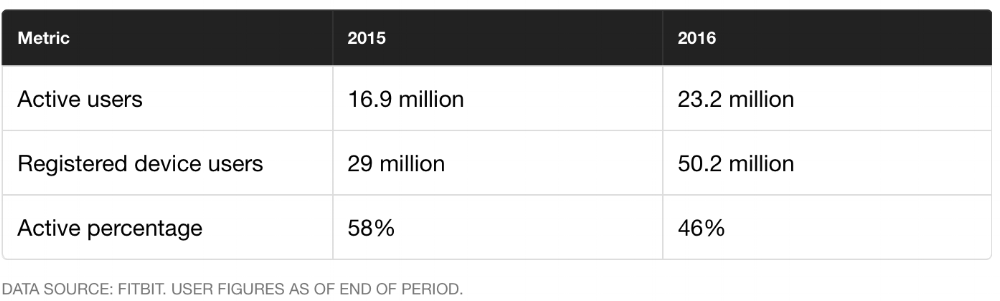
 I believe that the problem isn’t necessarily with Fitbit, it’s with us. Consumers treat Fitbit like many of the other health & wellness solutions out there, like a quick fix, when in reality, a Fitbit is really just another tool…and a good one at that.
Fitbit solves the painful problem of trying to track your total daily physical activity (exercise and movement of any kind). Our jobs and our lives are so incredibly sedentary (oftentimes not by our choice) and movement quantity, of any kind, is what many of us need to focus on first, before setting more advanced goals (i.e. getting “fit”).
The problem is that moving more requires us to carve time out of our already crazy schedules. Recently, a solution to this time crunch has become more and more popular: high-intensity interval training (HIIT). HIIT is becoming more and more popular, however, HIIT is also not a stand-alone health solution but another tool/part of the equation.
Contrary to popular belief, you cannot perform one HIIT session and call it day. One HIIT session will help an individual get closer to their goal of more movement, but one HIIT session will not cancel out an entire day’s worth of sitting. Nowhere in the history of humans have we been as inactive as we are today. In hunter-gatherer times, you could not drive your car to the hunt site, perform 45 minutes of high-intensity prey stalking/killing, and drive your car back home to sit on the couch or work in your office the remainder of the day. The more likely scenario involved walking several miles, stalking prey, waiting, stalking more, followed by a burst of activity, killing the animal (if you are lucky as there were likely many unsuccessful hunts), and carrying your kill back home (weight lifting).
Put another way in more modern terms, HIIT is akin to taking your kids to a sporting event, concert or buying them a lot of presents on Christmas. These individual actions will make your kids very happy in the short term, but to have a truly great relationship with your kids you really just need to be there for them. You need to spend time with them. I am not a parent so I might not know what I’m talking about, but I can speak from the side of the child. My parents never showered me with gifts or took me to concerts but they were always there for me and I have a great relationship with them.
But, this article isn’t about HIIT or parenting, it’s about tracking physical activity/movement. These days it is easy to log your distinct exercise sessions. Whether that is manually via a notebook or an electronic log, using an exercise watch (e.g., Garmin, more advanced Fitbits) or an app on your phone (e.g., Strava, Nike+), there are many tools available. But, how do you measure your overall total daily physical activity (exercise and other movement)? Fitbit offers a simple way to track your physical activity in an easy to understand, metric: total steps. I believe the basic function of a Fitbit should be to ensure that you spend enough time with physical activity to form a great relationship with your health and your body.
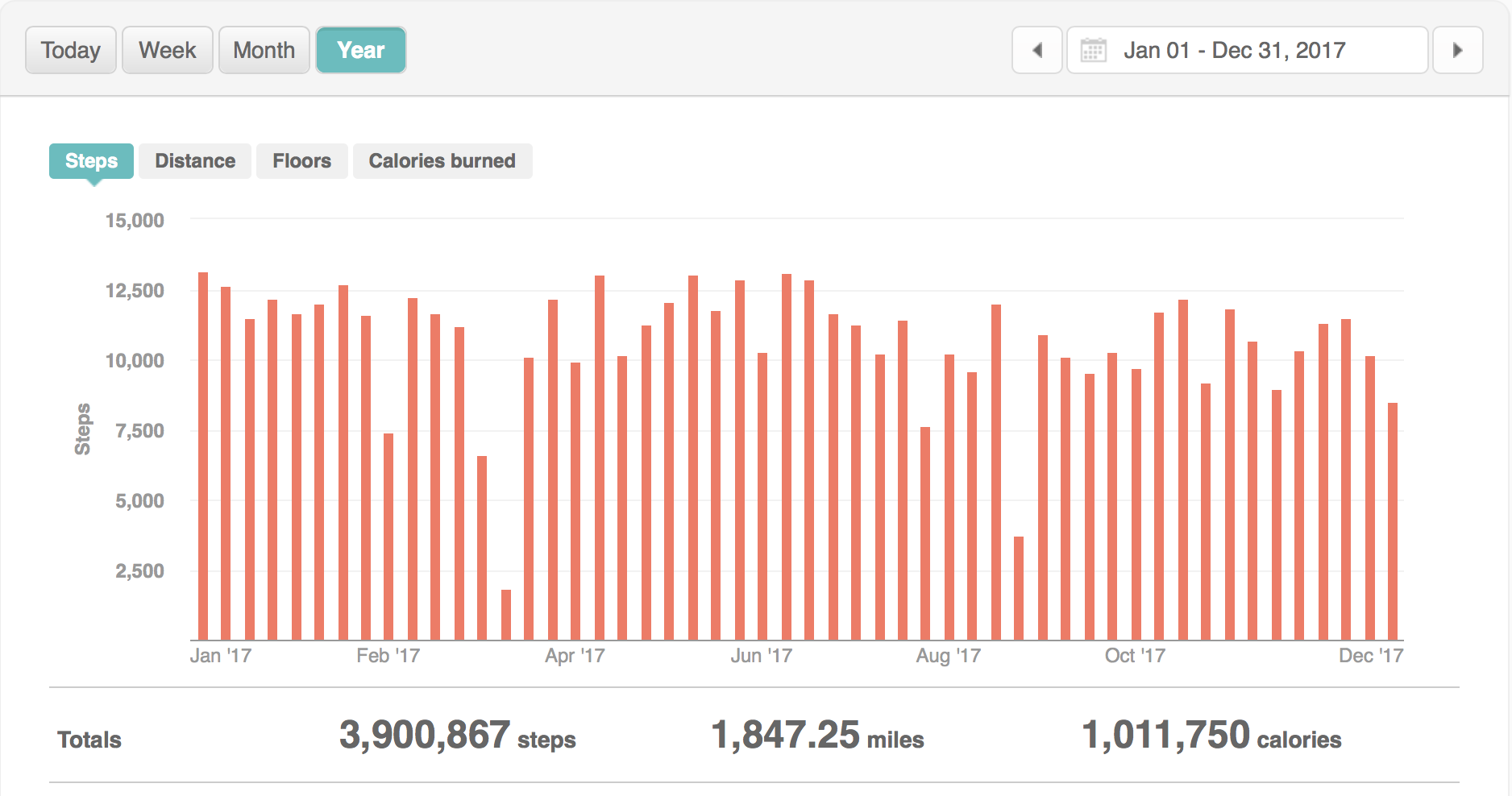
Now, to be fair and in full disclosure, I’ve used a Fitbit religiously since I purchased my first Fitbit Zip in November of 2014. Since then I have kept track of my steps, as shown in the graphics below:
Figure 1: Todd Weber’s Steps per Day from 2015 to 2017 Figure 2: Todd Weber’s Steps per Month (2017) as seen on the Fitbit Website. Consistency is King!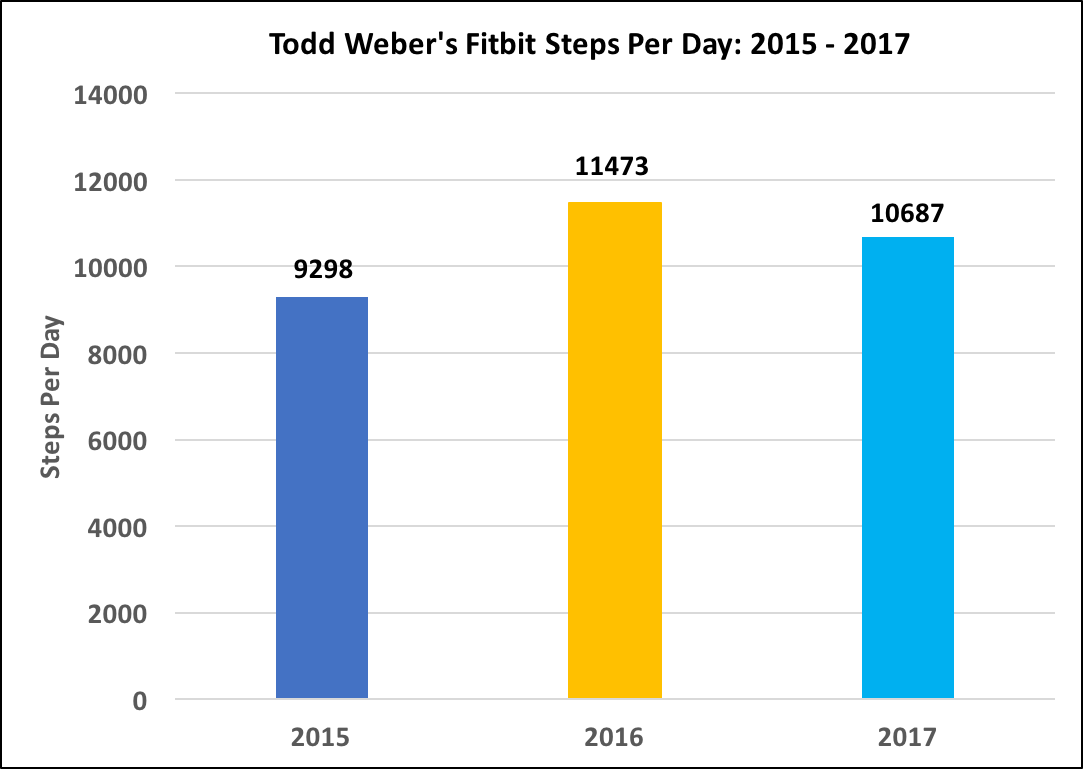
With life pulling us in so many different directions, what harm does passively tracking your physical activity do? Maybe you don’t want to know how physically inactive you are, maybe it makes you ashamed, maybe you’re not ready to make a change or don’t think you have the time to change. All I can say is that you can’t afford not to. You all know this and so do I. Let 2018 be the year where you keep track of your health. You don’t have to wear a Fitbit to keep track of your health but it makes it so much easier.
To good health, Todd Weber PhD, RD